On 21 February 2025, the Governor of Plateau State in Nigeria, Caleb Mutfwang, suspended all mining activities in the state because of escalating illegal mining. The governor’s statement linked illegal mining to insecurity, environmental degradation, and child labour.
Nigeria is rich in mineral deposits, yet the solid minerals sector contributes less than 1% to the country’s GDP – suggesting that much of the mining sector evades the government’s regulatory and revenue systems. Nigeria’s Minerals and Mining Act 2007 requires all mining activities to be conducted under government-issued licences to ensure human and environmental safety and revenue compliance.
Illegal mining costs the country about US$9 billion annually – an estimate of the undeclared and lost solid minerals, and the taxes these minerals could have generated.
Illegal tin mining has mushroomed in Nigeria’s Plateau State over the past five years, with thousands of abandoned pits sprouting across rural areas and urban centres.
Tin prices are estimated at around US$25 700 – US$26 000 per tonne, and global projections show the demand will be exponential in coming years due to the rapidly growing renewable energy sector. Tin is a versatile metal used in numerous applications, such as the manufacture of solar panels, grid infrastructure, electronic circuit boards and components, batteries and solder.
Illegal tin mining in Plateau State is a lucrative organised criminal activity involving both local and foreign miners, middlemen, elites and export brokers.
Evidence from arrests and local testimonies shows that foreign actors – from China, India, and Lebanon, among others – sponsor local illegal miners to supply tin ore. Residents say foreign nationals and collaborators buy or lease large farmlands from villagers, local landowners and community chiefs keen on quick cash for mining.
In March 2025, following Mutfwang’s mining suspension, several Chinese nationals (and local collaborators) implicated in large-scale illegal mining in the state were arrested at Jiasheng Nigeria Limited, a company without a mining licence. They were found with a truck loaded with bags of processed monazite, a tin ore by-product. Scant information on further government action following these arrests highlights concerns over state complicity.
Foreign players also sponsor local middlemen to buy tin ore directly from mine sites rather than from tin sheds in Jos, where it costs more. At the mine sites, tin ore is sold to middlemen for cash at about US$8 (₦12 000) per 0.45 kg. These middlemen or brokers sell the same amount for about US$14 (₦20 000) to tin traders in the Jos tin sheds or supply directly to export companies.
A Jos resident told ENACT: ‘Truckloads of tin ore are disguised as sharp sand or granite heading to warehouses owned by foreign nationals and their local collaborators, and government officials know this. But they do nothing.’
For export, illegally mined tin ore is mixed with that purchased from legitimate sources, disguising its origins. Sometimes, the illegally mined tin ore is exported using falsified documents. Tin is transported covertly via road networks from Jos to Lagos’s ports and then onward to countries like China, Hong Kong and Malaysia.
Tin extraction has gone through a boom, decline and resurgence cycle in Nigeria. Declining global demand in tin in the 1970s, combined with Nigeria’s shift to more lucrative crude oil, led to a drop in tin extraction. The decades of extraction since the early 1900s had depleted surface deposits, necessitating deeper-level mining and increasing extraction costs.
Major foreign firms abandoned their sites, which were taken over by often informal and unregulated artisanal and small-scale mining (ASM). Between the foreign operations and ASM, the landscape degraded into gaping pits that morphed into hazardous ponds and erosion gullies.
The recent wave of illegal tin mining has worsened these hazards, transforming fertile and residential landscapes into wastelands. These sites raise radiation levels in soils beyond safe limits, driving biodiversity loss and rendering land unusable for agriculture. The abandoned pits pose drowning risks for animals and children. Soil erosion has led to cracks and houses collapsing. Miners also risk chemical poisoning and being buried alive in collapsed pits.
Participation in illegal tin mining is linked to high unemployment and inflation rates in Nigeria. Many people are abandoning their businesses to venture into mining as it requires less capital investment.
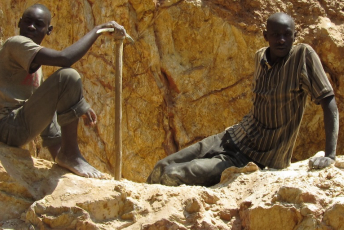
A Jos youth leader told ENACT that ‘mine pits are randomly dug across communities. If some tin ore is found in the area, large groups of people swarm to that location in no time and begin mining.’ Men dig the pits with rudimentary tools and use small mechanised equipment to extract tin ore; women and children participate in the washing process.
Children drop out of school to work full-time on mining sites. The harsh living conditions and prevalence of marijuana, tramadol and cheap synthetic drugs in these unregulated spaces expose them to substance abuse. Girls often fall victim to sexual exploitation or sex work.
Instability in Plateau State is another serious consequence. The governor says illegal tin mining has led to an influx of illegal foreign miners, which has ‘fuelled criminal activities such as banditry, kidnapping, drug trafficking, and the illegal possession of firearms.’
In May 2024, gunmen killed over 40 people in a raid on a mining community in Wase, Plateau State, torching homes and targeting residents amid resource disputes.
Since 2001, Plateau State has been a hotbed for sporadic violence, often linked to religious and ethnic tensions. But recent trends point to the role played by economic factors such as illegal mining. Many families displaced by terrorist and criminal violence in Plateau State are left with limited options, and engage in mining in neighbouring communities to make a living.
The Technical Committee on Mining Reform, established following the 2025 suspension of mining activities, has yet to complete its work. Since the suspension, though, the government has cleared some miners and traders to continue operating.
Nigeria’s Minerals and Mining Act of 2007 and the 2011 Minerals and Mining Regulations formalise ASM, including providing options to support, train and finance registered cooperatives. Yet, a lack of knowledge and overall low confidence in the country’s bureaucratic and centralised licensing processes discourage miners from compliance.
Decentralising the licensing process to local government levels to fast-track licensing and support miners is a much-needed long-term strategy of developing legal, viable local mining companies and expertise.
As the government considers potential remedies for illegal mining in the state, it must involve communities in the design, implementation and monitoring processes.
Ghana’s model shows there is potential for government-supported community mining schemes to enable those in vulnerable areas to practise safe, accountable and sustainable mining. Community mining schemes foster both community involvement in mining and beneficiation.
While such schemes can be politicised, if well implemented with oversight mechanisms in place, they could foster responsibility in communities, promoting accountability and interest in protecting farmlands and residential areas.
For security, the approach could further promote strong community policing measures, ensuring communities are vigilant of disruptive groups and organised criminal groups benefitting from the illegal extraction and trade of tin ore.
The government must focus its investigations, arrests and prosecutions on middlemen and export brokers, including local and foreign nationals who benefit.
Tightening regulatory oversight is also crucial, including investing in forensic capabilities to trace the origin of tin ore being exported and enhancing the capacity of customs officials to inspect cross-border flows.
This entails a concerted effort to combat corruption in the state, including among political elites, law enforcement officials and officials in the solid minerals and customs agencies that facilitate illegalities within the mining sector for payment.
Ndubuisi Christian Ani, Senior Researcher and Project Coordinator, ENACT, ISS